


A new conceptual framework called GLOW — Gluten Free Living: Optimised Wellbeing — aims to bring emotional and psychological support into routine coeliac disease care in the UK, according to a news item published by Coeliac UK on 20 October 2026. The framework comes out of a study funded by the National Institute for Health and Care Research (NIHR) and led by Dr Rose-Marie Satherley at the University of Surrey, with Coeliac UK acting as a research partner.
The study, published in the journal Health Expectations, involved 62 participants: 35 adults living with coeliac disease — including people from groups that are typically under-represented in coeliac disease research — and 27 healthcare professionals. Researchers gathered their views through a combination of group workshops and one-to-one interviews.
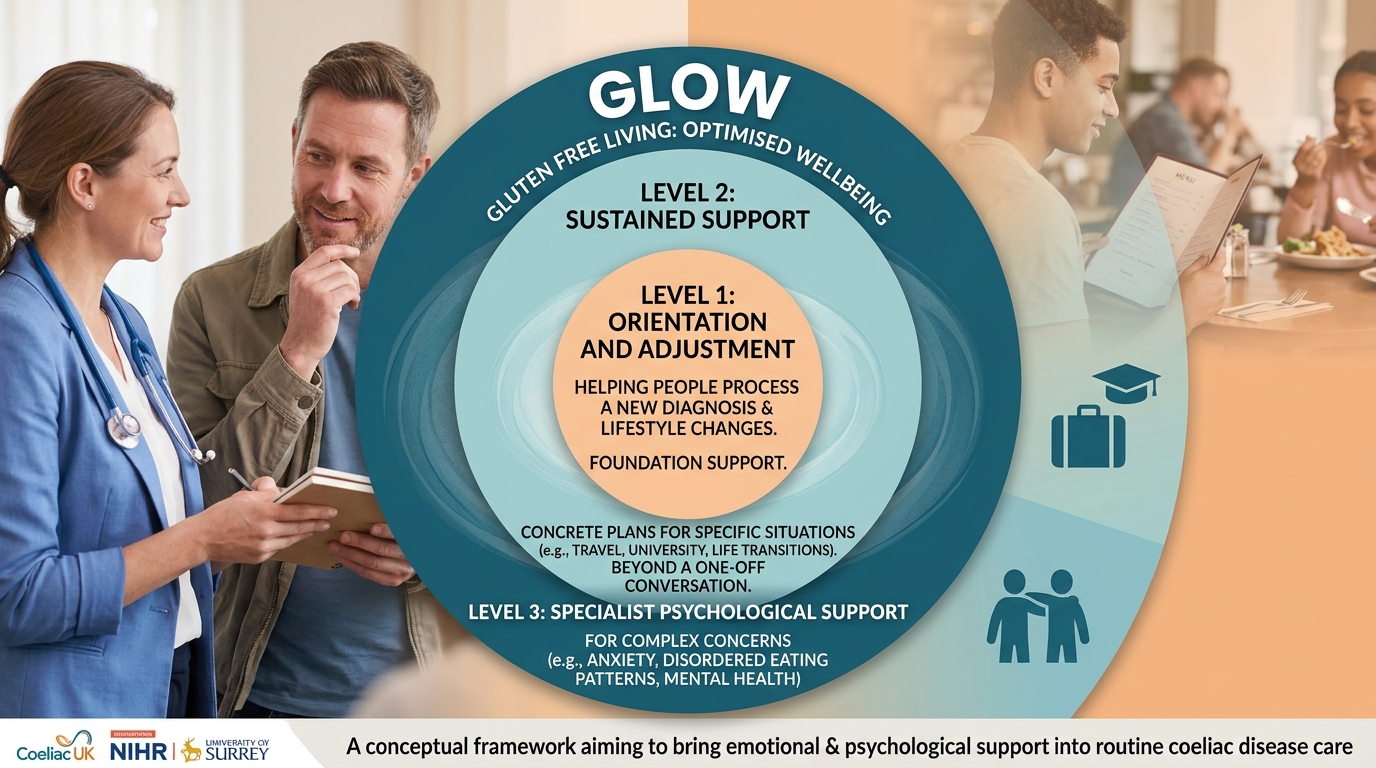
Three recurring themes emerged from that work. First, emotional and psychological support for people with coeliac disease is currently inconsistent, varying widely depending on where, and from whom, a person receives care. Second, living gluten-free has a measurable effect on self-image and identity, beyond the practical burden of avoiding gluten day to day. Third, managing coeliac disease demands ongoing mental, emotional and social effort that is frequently overlooked by both patients and clinicians, who tend to focus mainly on the physical and dietary side of the condition.
Building on these findings, the GLOW framework proposes three layers of support. The first is orientation and adjustment, aimed at helping people process a new diagnosis and the lifestyle changes it brings. The second is sustained support, which would include concrete plans for specific situations — such as travelling, moving away for university, or other major life transitions — rather than a one-off conversation delivered at the point of diagnosis. The third is specialist psychological support, reserved for people whose experience of the condition becomes significantly more complex, whether due to anxiety, disordered eating patterns linked to the diet, or other mental health concerns.
According to Coeliac UK, the next step is working out how to put GLOW into practice within the UK’s existing coeliac disease care pathways — something that will likely require coordination between the NHS, dietitians, and patient organisations such as Coeliac UK itself.
The research adds to a growing body of evidence suggesting that coeliac disease care needs to extend well beyond prescribing a lifelong gluten-free diet. For many people, a diagnosis also means navigating anxiety around cross-contamination, the social friction of eating out or travelling, and a shift in how they see themselves — challenges that a purely dietary approach to care does not address. If adopted more widely across the health service, a framework like GLOW could change how clinicians and patients alike think about living well with coeliac disease, rather than simply managing it from a distance.