

Ask any Spanish schoolchild where the Ebro River begins and they’ll tell you: Fontibre, in Cantabria. But science tells a slightly different story. In 1987, a team of technicians poured dye into a river in the Campoo region and waited to see where it would turn up. What they found changed the answer to a question that seemed settled: where does the most important river in northeastern Spain really begin?
In this deep dive, we’ll show you what the Fontibre spring looks like, what happened in that experiment, what you can visit at the Ebro River Interpretation Center, and where to eat gluten-free nearby, in Reinosa.

🚗 Fontibre is in southern Cantabria, in the Campoo region, so the easiest way to get around is by car, whether it’s your own or a rental: compare options at Discover Cars.
🛡️ We never travel without IATI travel insurance (with a 5% discount for Glutendtrotters readers). It’s essential on any trip.
📶 And if you’re visiting from outside Spain, a Holafly eSIM (also with a 5% discount for you) keeps you connected from the moment you arrive.
The Fuentona at Fontibre: The Official Source of the Ebro
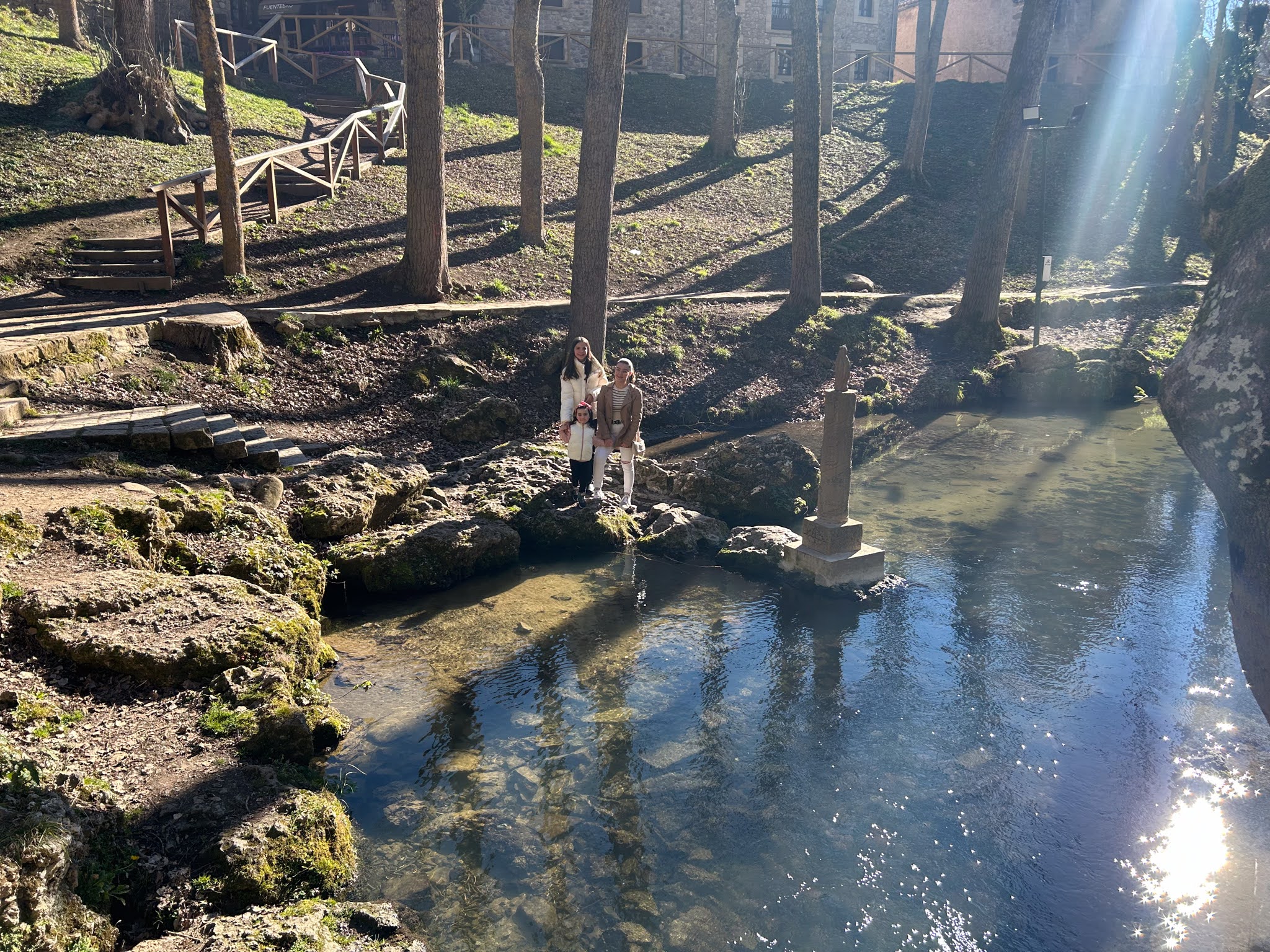
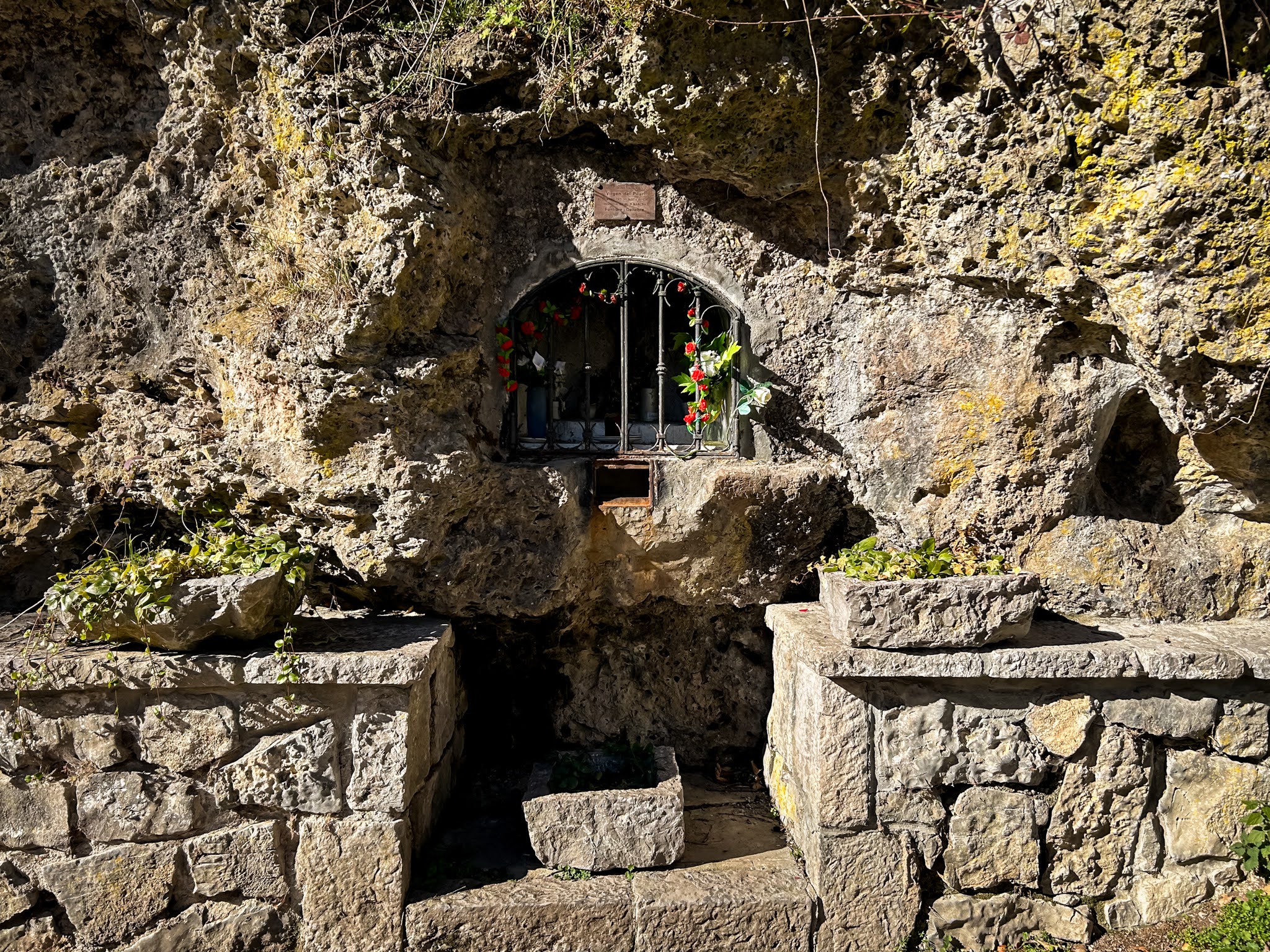
Fontibre is a small village in the municipality of Hermandad de Campoo de Suso, in southern Cantabria, very close to the town of Reinosa. There, at about 880 meters (2,900 ft) above sea level and surrounded by ash and poplar trees, is the Fuentona (literally, the “big spring”): the spring that tradition names as the birthplace of the Ebro River. A stone monolith topped with a small statue of the Virgin of the Pillar (Virgen del Pilar), engraved with the coats of arms of the provinces the river flows through, watches over the site.
There’s a parking area right next to it, and you only need to walk down a few yards to reach the spring itself, where there’s also a picnic area. Be very careful on the way down.
The 1987 Experiment That Changed the Answer
In September 1987, technicians from Spain’s Geological and Mining Institute (IGME) ran a test with fluorescein, a dye that turns water an intense green. They poured it into the Híjar River, near the village of Paracuelles, right where the river, carrying about 200 liters per second (over 3,000 gallons a minute), vanishes underground. After 32 hours, the dyed water surfaced at the Fontibre spring.
The conclusion was clear: much of the water that gushes out at Fontibre comes from the Híjar, which seeps underground and travels a little over 800 meters (about half a mile) through limestone before resurfacing at the Fuentona. The Híjar itself begins much higher up, in the glacial cirque of Pico Tres Mares (Three Seas Peak), in Alto Campoo, at around 1,850 to 1,880 meters (roughly 6,100 ft) above sea level. In other words, scientifically speaking, the Ebro is born in the mountains of Campoo.
Even so, Fontibre remains the official source, and it’s the one travelers visit. That’s no bad thing: it’s a lovely spot, and a geographic curiosity well worth sharing.
A Name with Latin Roots
The name gives it away: Fontibre comes from the Latin Fontes Hiberis, “the springs of the Ebro.” It shares its origin with the name of the river itself and, according to a widely repeated theory, with the word “Iberia” as well.
The Ebro River Interpretation Center
Right next to the spring is the Ebro River Interpretation Center, which tells the story and the uses of the river across two exhibition areas, with panels, audiovisual displays, and interactive exhibits. One of its highlights is an audiovisual presentation showing the river’s course from the air, from Cantabria all the way to its mouth in Catalonia.
The center is closed from December 15 to March 14. The rest of the year it opens Friday to Sunday (and Tuesday to Sunday in July and August), with weekday group visits by advance booking at +34 900 649 009. Exact opening hours vary depending on the source, so confirm them before you go.
The Ebro in Numbers
From this spring, the Ebro flows for about 930 kilometers (roughly 580 miles), the most commonly cited figure, although some sources give others, until it reaches the Ebro Delta in the province of Tarragona. Its river basin covers more than 86,000 km² (over 33,000 square miles), the largest in Spain. It carries more water than any other river that runs entirely within Spain, although the Duero, which empties into Portugal, has a greater flow.
What to See Near Fontibre
Your natural base for the visit is Reinosa, the capital of Campoo. You’ll find all the details in our guide to things to do in Reinosa and Campoo. Also very close are the Alto Campoo ski resort, where the Híjar rises, and the Ebro Reservoir. If you’re planning the trip from the UK, our guide on getting to Cantabria from the UK covers flights, ferries, and entry rules. And if you have time for a longer day trip, the Monastery of Santo Toribio, in the neighboring Liébana region, is also well worth the detour.
Where to Eat Gluten-Free Nearby
In Reinosa, we recommend La Mole. It’s an Italian restaurant we’ve visited a couple of times. The staff has a solid understanding of cross-contamination, and they serve gluten-free pizza.

How to Get There
The main access is from Reinosa: take the regional road CA-178 heading west toward the Alto Campoo ski resort, which leads straight to Fontibre. From Santander, take the A-67 motorway (Santander–Palencia). The easiest way to do it is to rent a car.
Fontibre shows that sometimes the most interesting part of a place is the story behind the postcard. Tell us in the comments if you already knew the Ebro’s secret.
Things to Do in Reinosa and Campoo: Skiing, Nature, and History
10 Essential Tips for Traveling to Cantabria
Gluten-Free Restaurants in Cantabria: A Local’s Guide for Celiacs
Frequently Asked Questions (FAQ)
Where does the Ebro River begin?
Officially, at the Fuentona spring in Fontibre, in the municipality of Hermandad de Campoo de Suso (Cantabria), at about 880 meters (2,900 ft) above sea level, close to Reinosa.
Is it true that the Ebro doesn’t really begin at Fontibre?
A 1987 IGME study using fluorescein dye showed that most of the water at Fontibre comes from the Híjar River, which rises in the Pico Tres Mares cirque and sinks underground near Paracuelles. Even so, Fontibre remains the official source.
How long is the Ebro River?
About 930 kilometers (roughly 580 miles) according to the most commonly cited figure, ending at the Ebro Delta (Tarragona). Some sources give slightly different values.
When is the Ebro River Interpretation Center open?
It is closed from December 15 to March 14. The rest of the year it opens Friday to Sunday, and Tuesday to Sunday in July and August, with weekday group visits by advance booking (+34 900 649 009). Confirm the hours before you go.
How do you get to the source of the Ebro from Reinosa?
Take the regional road CA-178 heading west toward the Alto Campoo ski resort, which leads straight to Fontibre.
FIND IT ON THE MAP